

Views: 0 Author: Site Editor Publish Time: 2026-08-31 Origin: Site


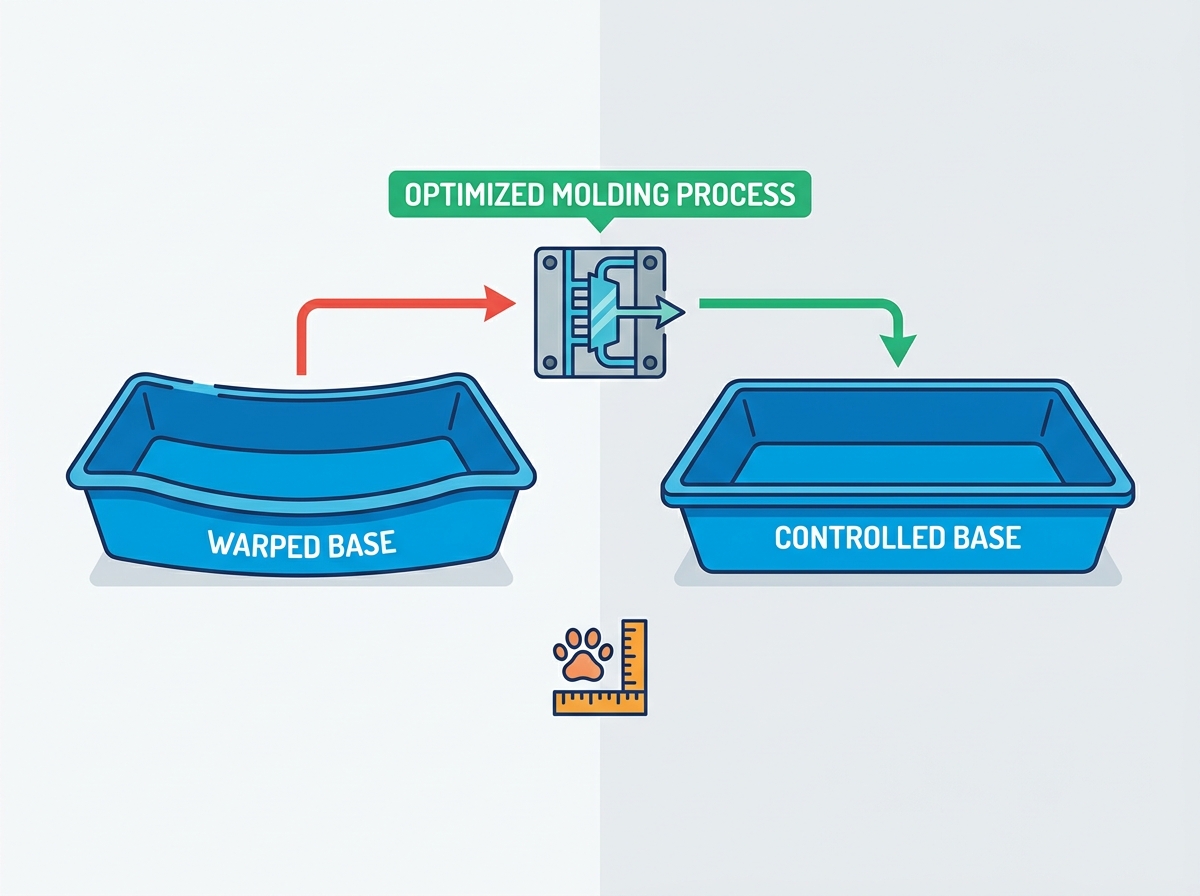
High scrap rates and assembly failures in large-format plastic manufacturing carry a compounding financial impact that destroys profit margins. Deep-draw and wide-span consumer products demand strict dimensional accuracy to function correctly on the assembly line and in the end user's home. Warpage in a cat litter box base or lid directly compromises the critical snap-fit seal. This specific defect leads to functional failures like urine leaks and odor escape. It triggers immediate consumer complaints and creates costly production bottlenecks due to rejected parts piling up on the shop floor. Shifting from reactive, trial-and-error machine adjustments to a systematic, engineering-first approach is necessary to stabilize production. Mitigating warpage requires upfront alignment between part design, material selection, mold construction, and precise process control before the first shot is ever fired.
Geometry Dictates Risk: Large, flat lids and deep-draw bases experience severe differential shrinkage; uniform wall thickness and structural ribbing are non-negotiable prerequisites.
Tooling is the Primary Defense: Optimizing cat litter box injection molds with symmetrical gating and aggressive, balanced cooling layouts prevents uneven stress distribution before processing even begins.
Process Control Cannot Fix Bad Design: While pack pressure and mold temperature adjustments can steer warpage, they cannot overcome fundamental flaws in part geometry or inadequate mold venting.
Total Cost of Quality (TCQ): Investing in upfront Moldflow analysis and conformal cooling yields a higher ROI by permanently reducing cycle times and scrap rates compared to post-molding fixtures or annealing.
Success for these products depends on dimensional stability across spans of 18 to 24 inches or more. You must ensure a flush interface between the base and the lid. Variations in cooling rates between the thick and thin sections of the box lead to internal stresses. These thermal gradients cause different areas of the plastic to shrink at different rates. When a thick section cools slower than an adjacent thin section, it continues to shrink, pulling the already solidified thin section inward and causing visible distortion.
Polymer chains align along the flow path during injection. Flow dynamics in the deep, vertical walls of the base differ vastly from the wide, flat expanse of the lid. This orientation-induced stress pulls the part out of shape as it cools. The plastic shrinks more in the direction perpendicular to the flow than parallel to it. Heat accumulation in the sharp internal corners of the base causes the bottom to bow upward, known as oil-canning. It can also cause the side walls to pull inward, ruining the assembly tolerance and making it impossible to attach the lid securely.
Large flat surfaces, like the top cover, lack inherent structural rigidity. Without proper ribbing, these flat expanses act like a drumhead, highly sensitive to any residual stress. Even a minor temperature differential of a few degrees between the core and cavity halves will cause a large lid to warp like a potato chip upon ejection.
Determining the root cause of distortion saves hours of wasted processing time. You must identify whether the warp is driven by temperature differences across the mold halves or by molecular alignment along the flow path. Thermal differential warpage usually bows toward the hotter mold half. Orientation-induced warp twists the part along the axis of material flow. By isolating these variables, process engineers can stop guessing and start applying targeted fixes.
Non-uniform transitions create localized sink marks. When heavy structural reinforcement ribs meet the nominal wall of the base, regional shrinkage differentials occur. These differentials pull the outer walls out of tolerance. Identifying the warp-sink connection helps pinpoint where coring or wall thickness adjustments are necessary. If a sink mark appears on the outside of the box opposite a heavy internal rib, the material is shrinking away from the mold wall, pulling the entire geometry out of alignment.
To properly diagnose warpage on the floor, technicians should follow a systematic isolation procedure. First, equalize the mold temperatures on both halves to see if the warp changes direction or severity. Next, adjust the pack pressure to isolate volumetric shrinkage issues. Finally, examine the part under polarized light if using clear resins, or use a grid projection to map the exact contour of the distortion. This data dictates whether the fix requires a process change, a tooling modification, or a complete part redesign.
Large parts require multi-gate hot runner systems to ensure symmetrical filling and reduce flow length. Unbalanced gating in deep-draw bases risks severe core deflection. When plastic pushes harder on one side of the core, it shifts the steel, creating uneven wall thicknesses that guarantee warpage. A core shift of just a few thousandths of an inch on a deep draw part will cause one wall to pack out completely while the opposite wall remains under-packed and shrinks excessively.
Gate placement near the thickest sections allows for optimal packing. This minimizes shrinkage variation across the part. Direct sprue, edge gating, and valve gating each offer different control levels. Valve gating provides the best sequential control for large flat lids, allowing you to open gates progressively to manage the weld lines and pressure distribution. You must use short-shot studies to physically audit and verify balanced filling patterns across all cavities and gates of cat litter box injection molds.
Gating Strategy | Application | Warpage Control Impact |
|---|---|---|
Direct Sprue | Single cavity, simple bases | Poor. High stress at the gate, prone to center bowing. |
Edge Gating | Multi-cavity, flat lids | Moderate. Can cause orientation-induced warp along the flow path. |
Sequential Valve Gating | Large, complex bases and lids | Excellent. Controls flow front, minimizes weld lines, balances pressure. |
You must extract heat uniformly from the core and cavity halves. Traditional baffles and bubblers often fail to reach the deep core sections of the base effectively. Conformal cooling inserts follow the exact geometry of the part, providing superior thermal management in hard-to-reach areas. By 3D printing the core inserts with internal water channels that wrap around the corners, you eliminate the hot spots that cause oil-canning.
Running different temperatures on the core versus the cavity can steer warpage directionally. This intentional "Delta-T" (temperature difference) can slightly bow a lid to ensure a tensioned, tight seal against the base. However, this requires highly responsive temperature control units and well-designed water circuits. If the water flow is turbulent and the channels are clean, the heat transfer will be efficient. Scale buildup in the cooling channels acts as an insulator, destroying the thermal balance and reintroducing warpage over the life of the mold.
Perimeter venting prevents gas traps that cause short shots and localized overheating. Burn marks alter material properties and induce warp. You must calibrate vent depths and widths precisely. This allows maximum gas evacuation without causing flash. When air is trapped in the cavity, it compresses and superheats, degrading the polymer and creating a weak, brittle area that shrinks unpredictably.
Deep corners where traditional venting is physically restricted benefit from porous mold steel inserts. Vacuum traps during the ejection of deep bases cause mechanical deformation. The part is still hot and pliable during ejection. You need air poppets and a balanced ejector pin layout to break the vacuum and push the part off the core evenly.
Map out the final fill locations using mold filling simulation software.
Machine primary vents at these exact end-of-fill locations, keeping depths appropriate for the specific resin viscosity.
Install air poppets on the deep core to break the vacuum seal before the ejector pins engage.
Utilize a stripper plate or a high-density ejector pin layout to distribute the ejection force across the entire rim of the base.
Standard resins used in pet product manufacturing present different shrinkage challenges. Semi-crystalline polymers like Polypropylene (PP) and High-Density Polyethylene (HDPE) have high, anisotropic shrinkage rates. Amorphous polymers like ABS offer lower, more uniform shrinkage. The molecular structure of the plastic dictates how it behaves as it cools from a melt to a solid state.
Material | Shrinkage Rate | Warpage Risk | Performance Characteristics |
|---|---|---|---|
Polypropylene (PP) | 1.5% - 2.0% | High (Anisotropic) | Highly cost-effective, excellent chemical resistance to urine. |
HDPE | 1.5% - 3.0% | High | Durable, impact-resistant, prone to severe bowing on flat surfaces. |
ABS | 0.4% - 0.8% | Low (Isotropic) | Higher raw material cost, excellent dimensional stability and rigidity. |
PP is cost-effective and chemically resistant but highly prone to warpage. ABS offers dimensional stability but at a higher raw material cost. You must weigh these trade-offs based on the final assembly requirements. If the design relies on a tight snap-fit, the dimensional stability of ABS might justify the higher material cost by eliminating scrap and assembly failures.
Nucleating agents speed up crystallization and reduce cycle times. They help the plastic set up faster in the mold, which can stabilize dimensions. By providing a site for crystals to grow, nucleating agents create a finer, more uniform crystalline structure, which reduces the overall shrinkage and mitigates some of the anisotropic behavior of PP.
Adding glass fibers increases stiffness but complicates shrinkage. Fiber orientation during flow exacerbates anisotropic shrinkage. The fibers align with the flow path, restricting shrinkage in that direction while allowing normal shrinkage transversely. This causes unpredictable twisting, especially in large, flat lids. If you must use glass-filled resins, the gate locations must be engineered specifically to control the fiber alignment and balance the resulting stresses.
Decoupled molding techniques separate the filling and packing phases. You transition from velocity control for filling 95% of the mold to pressure control for packing out the remaining 5%. Adequate pack pressure compensates for volumetric shrinkage as the plastic cools. If you try to fill and pack in one continuous velocity stage, you will overpack the gate area and underpack the extremities, guaranteeing severe warpage.
Holding pressure must be maintained until gate freeze occurs. If you drop holding pressure too early, molten material flows back out of the cavity into the runner system. This causes severe sink marks and localized warpage near the gates. To determine the correct hold time, perform a gate seal study by weighing parts at incrementally longer hold times until the part weight stabilizes.
Cooling time is a critical balance. Prematurely ejecting a thick-walled base before the center of the wall has fully solidified causes post-molding crystallization. This leads to severe delayed warpage hours after the part leaves the press. The outer skin may feel solid, but the molten core will continue to shrink, pulling the rigid skin inward and distorting the geometry.
Use thermal imaging cameras at the press to verify uniform part temperature upon ejection. Hot spots indicate poor cooling circuit performance or inadequate cool time, both of which lead to distortion. If one side of the part is ejecting 20 degrees hotter than the other, you have a tooling issue that process parameters cannot permanently fix.
Secondary operations are sometimes necessary for parts that still exhibit marginal warpage. Custom cooling jigs, or shrink fixtures, hold lids flat as they reach ambient temperature. This forces the part to cool in the desired shape. Operators place the hot part onto an aluminum fixture and clamp it down immediately after ejection.
Annealing involves controlled heating and cooling to relieve internal stress. Frame this as a last-resort mitigation strategy. It increases labor, floorspace requirements, and overall cycle time. Upfront mold design is always superior to post-molding fixes. Relying on fixtures means you are treating the symptom rather than curing the disease at the tooling level.
Evaluating tooling quotes requires looking beyond the initial price tag. Predictive software like Moldflow, high-grade tool steel, and complex cooling layouts carry a premium cost. However, they prevent catastrophic failures during production. A cheap mold with straight-drilled water lines will produce warped parts that require constant process tweaking and high scrap rates.
Calculating the break-even point justifies this investment. A 5% reduction in scrap and a 10-second reduction in cycle time over a 500,000-part run heavily favors investing in high-quality tooling. Cheap molds produce expensive parts. When you factor in the cost of rejected assemblies, lost machine time, and operator frustration, the premium paid for conformal cooling and sequential valve gating pays for itself within the first few months of production.
Audit your current scrap rates to identify specific warpage trends and isolate whether the issue is thermal or orientation-induced.
Request a comprehensive tooling cooling audit for your existing molds to locate thermal bottlenecks and scale buildup.
Initiate a strict Design for Manufacturability (DFM) review for your next large-format pet product iteration before cutting any steel.
Implement thermal imaging at the press to monitor ejection temperatures and standardize cooling times across all shifts.
A: Bowing, or oil-canning, is typically caused by heat accumulation in the sharp internal corners of the base and differential cooling between the core and cavity. This thermal imbalance creates internal stresses that pull the flat bottom upward as the plastic solidifies.
A: Gate location dictates the flow path and molecular orientation of the plastic. Placing gates near the thickest sections ensures proper packing and minimizes shrinkage variation. Unbalanced gating leads to uneven pressure distribution and core deflection, directly causing warpage.
A: Adjusting cooling time can reduce warpage by allowing the part to solidify fully before ejection. However, it cannot eliminate warpage caused by fundamental flaws in part geometry, uneven wall thickness, or poor mold cooling layout.
A: Amorphous polymers like ABS offer the lowest and most uniform shrinkage rates, making them highly stable. However, Polypropylene (PP) is more commonly used due to cost and chemical resistance, despite its higher warpage risk.
A: Post-production fixes include using custom cooling fixtures to hold the lid flat while it cools to room temperature. Annealing can also relieve internal stresses, but both methods add significant labor and time costs.
A: While not strictly mandatory, conformal cooling is highly recommended. It provides uniform heat extraction in deep, hard-to-reach core sections where traditional straight-line water channels fail, drastically reducing thermal-induced warpage and cycle times.


